.svg)


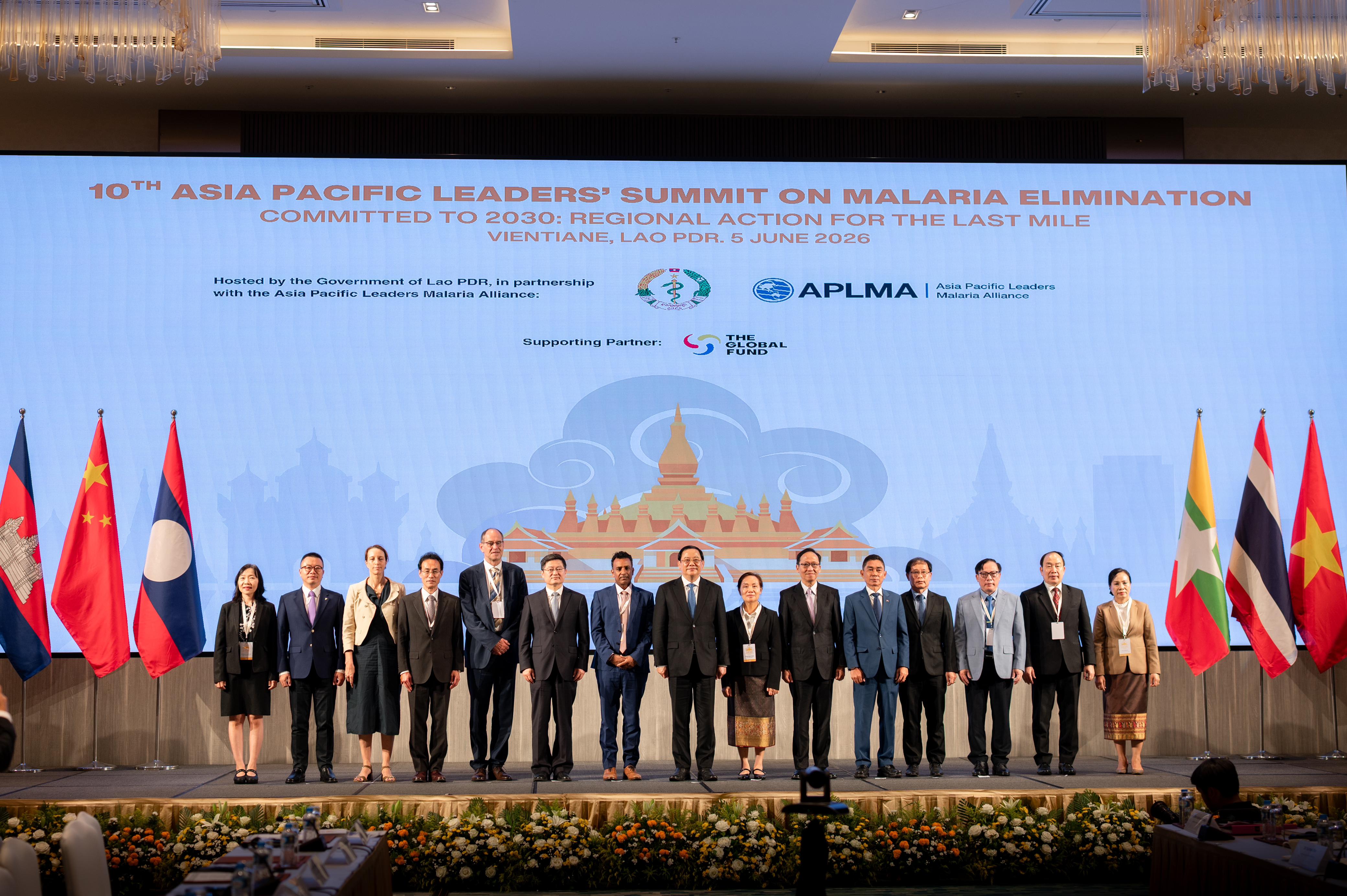
Vientiane, 5 June 2026 — Senior health officials across the Greater Mekong Subregion (GMS) have reaffirmed their commitment to eliminate malaria by 2030 at the 10th Asia Pacific Leaders’ Summit on Malaria Elimination, held in the presence of His Excellency, Prime Minister Sonexay Siphandone of the Lao People’s Democratic Republic (Lao PDR).
Hosted by the Government of Lao PDR in partnership with the Asia Pacific Leaders Malaria Alliance (APLMA), it brought together health ministers from Lao PDR and Myanmar, alongside senior representatives from Cambodia, China, France, Japan, Thailand, Timor-Leste and Viet Nam as well as the Asian Development Bank, the Global Fund, and the World Health Organization. Under the theme “Committed to 2030: Regional Action for the Last Mile,” the Summit reinforced the urgent measures needed to accelerate malaria elimination across the GMS.
At this year’s Summit, health ministers and senior officials in attendance renewed their commitment to eliminate malaria in the subregion through a Joint Call to Action. The Joint Call to Action sets out the need for tailored strategies, sustained political and domestic financial support, stronger partnership, and greater regional accountability to protect hard-won gains. This builds on regional action taken in 2018, when health ministers from six GMS countries signed a joint Ministerial Call for Action at the World Health Assembly to eliminate malaria in response to the growing threat of multidrug-resistant malaria.
Reflecting on the shared progress of the GMS – including a 67% decline in malaria cases over the last 15-year period1, H.E. Prime Minister Siphandone emphasized that these gains were built on collective dedication, political will, and partnership:
“I am proud to reaffirm Lao PDR’s commitment to achieving our national malaria elimination goal by 2030. We recognize that this goal requires not only continued technical and programmatic effort, but also a deepening of domestic ownership – of financing, of governance, and of accountability. We must be honest about what lies ahead. The epidemiological picture across the GMS is not uniform, and we face challenges that are both familiar and new. These challenges require our honest attention, our collective ingenuity, and our sustained commitment. It is precisely in this context that today's Summit carries such importance."
In conjunction with the Summit, the Ministry of Health of Lao PDR also announced four major publication milestones: 1) the Transition and Sustainability Roadmap for Malaria 2) the National Strategic Plan for Malaria Elimination 2026–2030 3) the Prevention of Re-establishment Guidelines and 4) an integrated roadmap to align malaria programme with TB and HIV responses.
Highlighting the Summit as a moment to sustain momentum, Honorable Minister for Health Baykham Khattiya of Lao PDR emphasized the importance of continued commitment and collective effort:
“We are proud of the progress our country has made, and we are under no illusion that the work is completed. We stand before you today as a country committed to finishing what we have started — transparently, accountably, and in the spirit of regional solidarity that has always been the foundation of our shared endeavor.”
Echoing the need to protect progress while sustaining momentum toward elimination, Dr. Sarthak Das, Chief Executive Officer of APLMA said:
“The progress are significant — but they remain fragile. With elimination now in sight, this is the moment to sustain political commitment, strengthen domestic financing, and invest in the systems needed not only to stop transmission, but to prevent malaria from returning. The last mile is often the hardest, but with continued country leadership and regional solidarity, it is a goal well within reach.”
2026 is crucial for the subregion. For Cambodia, Lao PDR, and Viet Nam, where cases remain in the low hundreds, the next three years will be critical. To achieve malaria-free certification, each country must first record three consecutive years with zero indigenous cases. Sustaining progress will depend on strong programme planning, full implementation of prevention of re-establishment measures, and surveillance systems that can rapidly detect and respond to cases.
For Myanmar and Thailand, the path to elimination remains more complex, with persistent transmission in border areas and among vulnerable and hard-to-reach communities. Accelerating progress will require refreshed strategies that reflect current epidemiological realities, including targeted interventions in underserved areas and sustained efforts to reach populations at greatest risk. Together, these differentiated approaches will be essential to keep the subregion on track toward its 2030 goal.
1 Comparison based on 2010 and 2024 data from the World Malaria Report 2025 (WHO), which provides the latest available figures up to 2024.
You may also like